

Reconciliation in my art didn’t arrive as a grand revelation. It came as a slow, uncomfortable noticing that I was being pulled in opposite directions and still choosing to stand in the middle.
On one side is my clinical life: evidence hierarchies, risk–benefit ratios, treatment plans, outcome measures. On the other side is my art: intuition, ambiguity, emotional resonance, beauty that refuses to be quantified. For a long time, I treated these as separate rooms in the same house. I’d walk out of one and into the other, changing shoes at the threshold. But the more I photographed, the less that separation made sense.
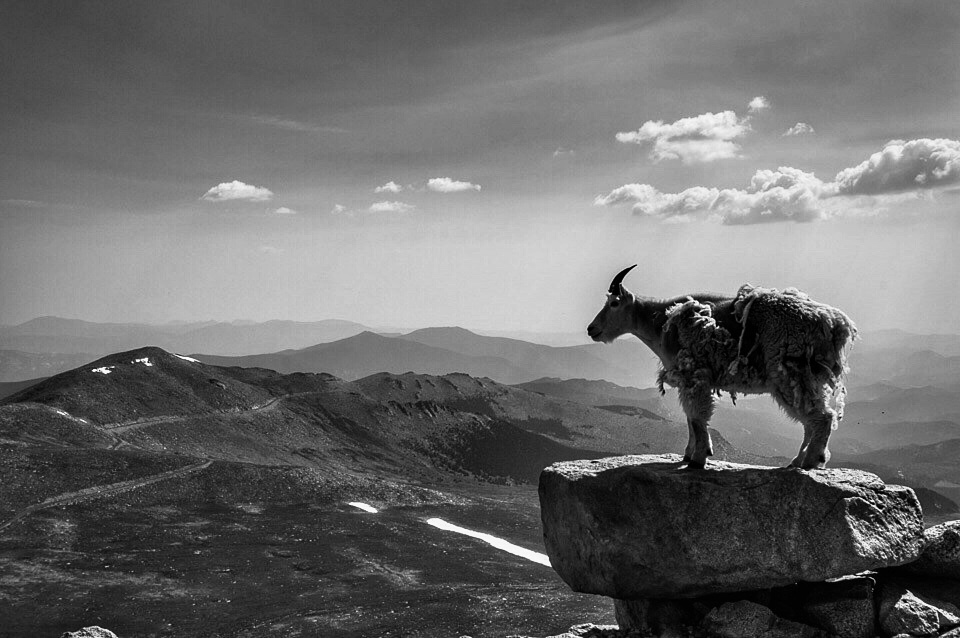
Take the mountain goat, for example. In the photograph, you might see just an animal in its environment, its molting coat caught by the wind. When I made that image, I was aware of so many layers at once: the biology of the coat changing with the season, the harshness of the terrain, the subtle stress of a warming climate on alpine ecosystems, my own body working at altitude to stand still enough to press the shutter.
Eric Robertson, PT, DPT, MFA
Associate Professor Clinical Physiotherapy
Eric Robertson is Associate Professor and Senior Coordinator of Hybrid Faculty Development at University of St. Augustine and the CEO and co-founder of Brainsmith, LLC, an education innovation company. Eric received an MFA degree from the San Francisco Art Institute in 2021 in studio arts and exhibits his art work centering around reflections on our relationship with the environment around the world.Visit www.ericrobertson.com to see some of his artworks.
My clinician-brain wanted to assess: How is this organism coping? What are the threats to its habitat? My artist-brain wanted to marvel. To look at the line of that spine against the sky, the way texture and light tell you it’s alive. The way the photo makes you FEEL! Reconciliation, for me, is not choosing one of those responses—it’s letting both exist, and allowing the photograph to hold the tension between them. I’m not just looking at a mountain goat. I’m looking at relationships: between species, between land and weather, between my presence and its awareness of me. I’m witnessing our combined existence on the planet in that moment.
The magnesium plant near the Great Salt Lake is an even more complicated reconciliation. These landscapes are, undeniably, beautiful: impossible colors, geometric lines, shimmering reflections that look almost extraterrestrial. When I first began photographing them, I felt a kind of guilt. How could I find aesthetic pleasure in what is also a site of extreme environmental harm? Was I beautifying damage? Was I, in some way, complicit? Well, yes…
The triptych of magnesium images is my attempt to stay with that discomfort rather than bypass it. There is reference in art for this concept. Donna Haraway’s piece, “Staying with the Trouble” is a good reference reading for this concept, and Richard Misrach’s body of photographic work is perhaps a visual representation of this concept. Each panel of the triptych is a different facet of the same reality: chemical, ecological, and emotional. There is no neat “before and after” narrative, no restored landscape at the end of the story. Instead, the work challenges us to think about what it means to care about a place that has already been altered? It causes us to value this non-living space and worry about it.

In rehabilitation, reconciliation often means accepting that a full “return to normal” is not possible, while still committing to meaningful repair, adaptation, and participation. You don’t negate pain, history, or damage; you integrate them into a new way of moving through the world.
My art practice is starting to feel like that. I can’t undo the industrial scars on the land. I can’t single-handedly fix climate change. But I can stand there with my camera, fully aware of the complexity, and choose to look closely rather than look away, to witness it. The reconciliation is not between “good” nature and “bad” industry; it’s between my own impulses to fix, to grieve, to appreciate, and to respond. And so, I present my photos as reflections in reconciliation with the environment.
The gallery image from Metaphors of Recent Times is another kind of reconciliation. In that room, my magnesium work hung in conversation with other artists’ responses to our shared moment in history. Political upheaval, climate grief, personal vulnerability—they all shared walls.

Walking into that exhibition, I realized that my photographs were no longer just about me witnessing a landscape. They had become part of a collective act of seeing and caring. My private reconciliations—between science and art, beauty and damage, intuition and analysis—were now out in public, rubbing up against other artists’ questions and convictions.


Seeing, for me, has become a practice of holding contradictions without rushing to solve them. I can love the luminous pinks of an evaporation pond and still be troubled by what they represent. I can admire the resilience of a mountain goat and still worry about the shrinking snowpack it depends on. I can hang my work in a beautiful gallery and still know that it emerged from messy, unresolved questions.
Reconciliation, then, is not about making these tensions disappear. It’s about acknowledging them, staying with them, and letting them reshape how I move through the world—as an artist, as a clinician, and as a person who cares. Much of my study on this has been shaped by indigenous people, and I would be remiss to not link to some of this writing (here and here).
When I really see, I cannot help but care.
And when I really care, I cannot remain unchanged.

All photos by Eric Robertson: www.ericrobertson.com
Love your article about complexity – it shows a lot of depth! Am very grateful for your work.
Yours sincerely,
Thomas (a physiotherapist from Germany)