
The Posthuman Walking Project is a transdisciplinary collaboration of physiotherapy and visual arts academics and persons with experience of living with persistent pain. The project explores the entanglement of human and non-human entities when walking with pain.
As a group we sought lines of flight from traditional or pre-defined research methods and explored the potential of rhizomatic methods which responded to the project’s activities. Our collaborative process started as discussions of what to do and how to do it, but evolved into conversations that considered possibilities and becoming, and this approach is explored in our paper Staying with the Trouble, a Rhizomatic Approach to Posthuman Methods: Assemblages and Becoming in the Posthuman Walking Project
Our ‘data collection’ was initiated by academic partners filming walkers as they shared journeys that were meaningful in relation to their pain experience and included the use of reflective questions that brought a focus to the relationship between walking, pain and landscape.
As the project grew, walker partners became confident in filming independently, and the team recognised how each walker and environment revealed new assemblages of landscape-pain-response-time in rural and urban cultures. As the walkers took the lead what was surprising, and due to our project aims also disconcerting, was that the experience of pain retreated as other entities were acknowledged as formative elements of the walking experience. Our aim was not to explore walking as, quite the contrary, as we had imagined that for some, walking would be inhibited or aggravated by their pain. However, for those in our project, the open approach we took to every stage of data collection illuminated how walking, particularly when in natural environments such as parks, downland and woodland, can de-centre pain. We also came to understand that the task of filming itself provided a line of flight away from the dominance of pain as the walker’s focus moved away from themselves to accept, understand and acknowledge the varied assemblages of walking-pain-culture-place-task.
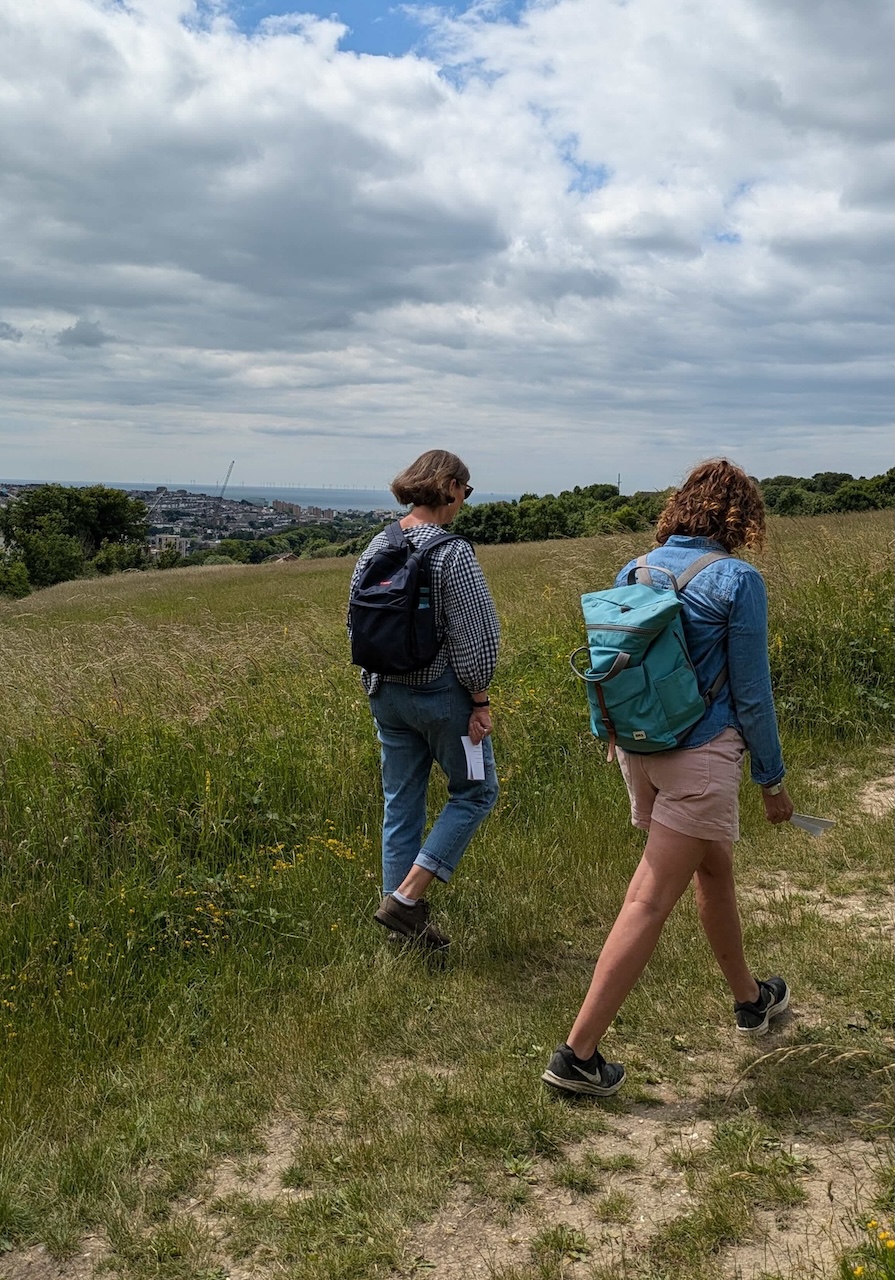
Shirley Chubb & Clair Hebron
Shirley Chubb is an artist and Emerita Reader in Interdisciplinary Art at the University of Chichester. Often working collaboratively, her research focuses on broadening the potential of the visual arts as a communicative tool.
Clair Hebron is a physiotherapist educator and researcher exploring the intersection of art and science. Her work explores creative methods to examine lived experience, understanding and critical insight within critical practice.
Profile Image: Shirley Chubb & Clair Hebron, Brighton UK, 2024. Photographer: Toby Bain.

Fig. 1 Walker partner John documented his walk from work in urban Manila during the January dry season. PWP Project Film Still 2024. Photographer: John (pseudonym).
Additionally, we came to recognise that each environment was encountered as an active, varied and dominant collaborator in walking. In the Philippines walkers documented urban locations where the purpose of walking was for transport rather than a leisure activity. This contrasted with assemblages in the global north, as illuminated by walker-partner Fe who, in one of our meetings, reflected that ‘interestingly I could not bring myself to take an urban walk – I seem to clearly define ‘walking’ as in nature, what I do in urban environments is “getting around”. Another striking contrast was one walker’s experience in the dark and light of the polar north winter and summer environments.
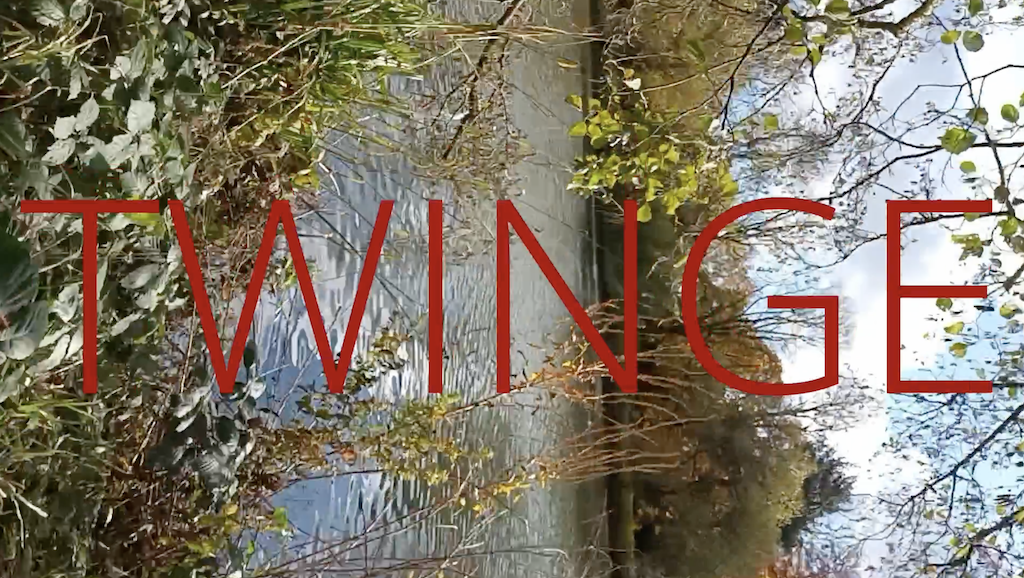
Fig. 2 Walker partner Natalie contributed key editing decisions to reflect her experience of the entanglement of pain and walking in the UK. Project Film Still, 2024. Photographer: Natalie Sharratt.
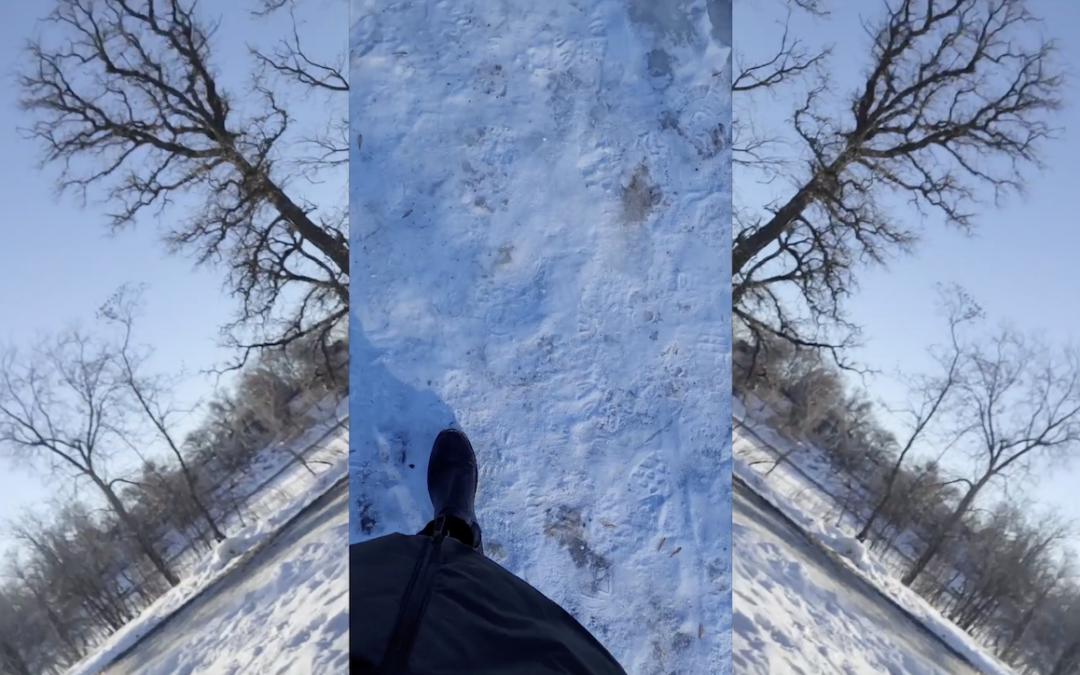
New exploratory methods of filming by artist and researcher Shirley Chubb, led to walker partners also experimenting with filming techniques – such as attaching the mobile phone to their leg or to companion dogs. These approaches reintroduced considerations of pain and led us to think about more than human experiences; of animals walking in pain and the pain of the landscape itself.
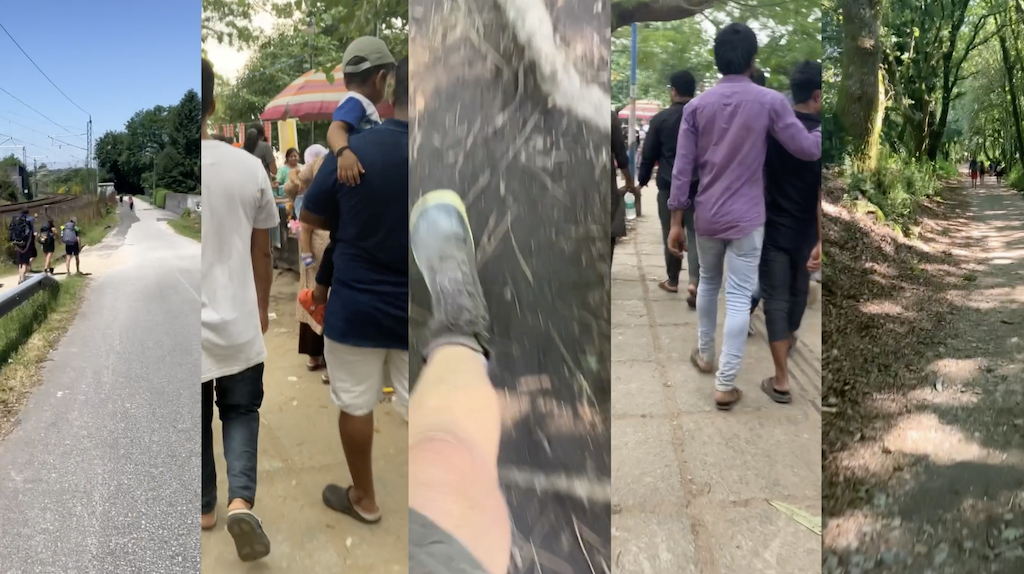
Fig. 3 Walker partner Branwen documented her walks across the Camino between Porto and Santiago, and in Kerala, India. Project Film Still, 2024. Photographer: Branwen Lorigan.
As our collaborative process grew, walker partners contributed in other ways, for instance partner walker John’s words made sense of the meaning of his walk. Another partner walker, Natalie, wrote a poem which was incorporated into her film and, taking this process further, she also collaborated with Shirley on editing decisions in the use of text, colour, and the specific addition of disruptive phases of footage to convey the entanglement of pain and place.
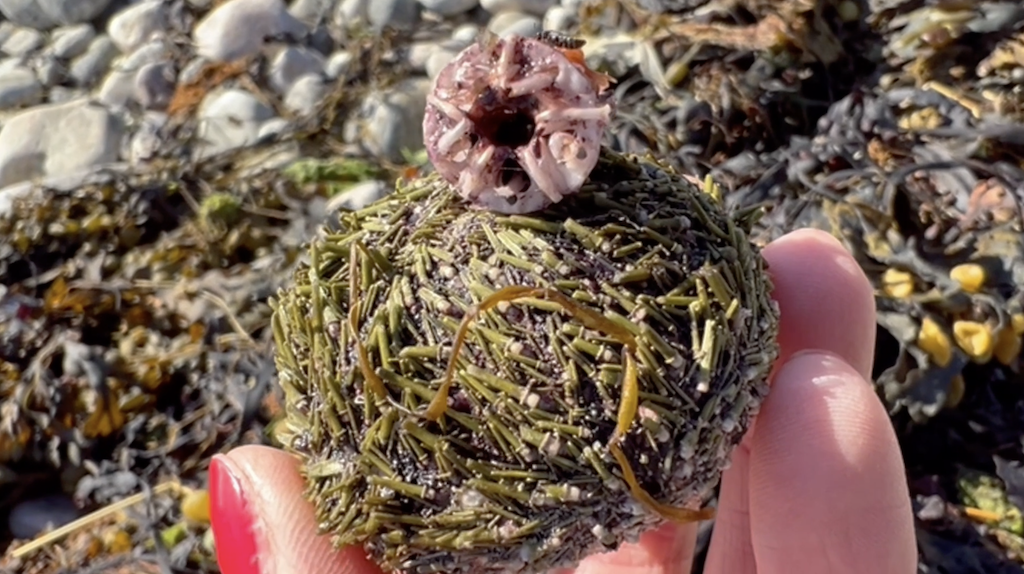
Fig. 4 Walker Partner Lena walked in Northern Norway during the polar summer. Project Film Still, 2024. Photographer: Lena Gudd.
As a whole, the project films offer a glimpse in to the multiplicity of walking and are the primary findings of our project. The project website captures the growing awareness of individual walkers as they reflect on the sense of partnership they felt with the landscapes they walked in, their entanglements with pain and the contribution these realisations made to their wellbeing.
We invite you to watch the films, make your own interpretations and reflect on the possibilities of an otherwise physiotherapy with a more than human focus that actively engages with environment.
Header image: Walker partner Jeni captured snow and sky by recording with a mobile phone attached to her leg and viewing upwards during the Canada spring. PWP Project Film Still, 2024. Photographer: Jeni Ross.