
A few years ago, I shared here my decision to pursue a master’s degree in environmental sciences (Boiko, 2021). Today I’m excited to give an important update: my master’s thesis was recently published in a peer-reviewed journal, presenting what appears to be the first quantitative environmental assessment of physiotherapy rehabilitation in the context of an anterior cruciate ligament (ACL) injury (Boiko et al., 2025). In this post, I’d like to briefly explain what we assessed, summarise the main results, and open the door to a discussion on how evidence-based practice and ecological transition in healthcare can support one another.
First, let me briefly explain what Life Cycle Assessment (LCA) is: it is a methodology that evaluates the environmental impacts of a product or service from cradle to grave, including raw material extraction, manufacturing, transport, use, and disposal (Saadé & Jollier, 2024). LCA results allow to prioritise actions according to their real impact, in order to avoid deploying all resources on symbolic measures with only marginal effects. Applying LCA to physiotherapy required extensive data collection: building energy use such as heating and lighting, patient and staff transportation, rehabilitation and other equipment, laundry, and waste management (Figure 1). Each of these components has its own life cycle and modelling them accurately requires knowledge on specialised databases and software. Still, the most challenging part was gathering reliable on-the-ground data, a task made possible thanks to the generous help of the physiotherapists who supported the project.
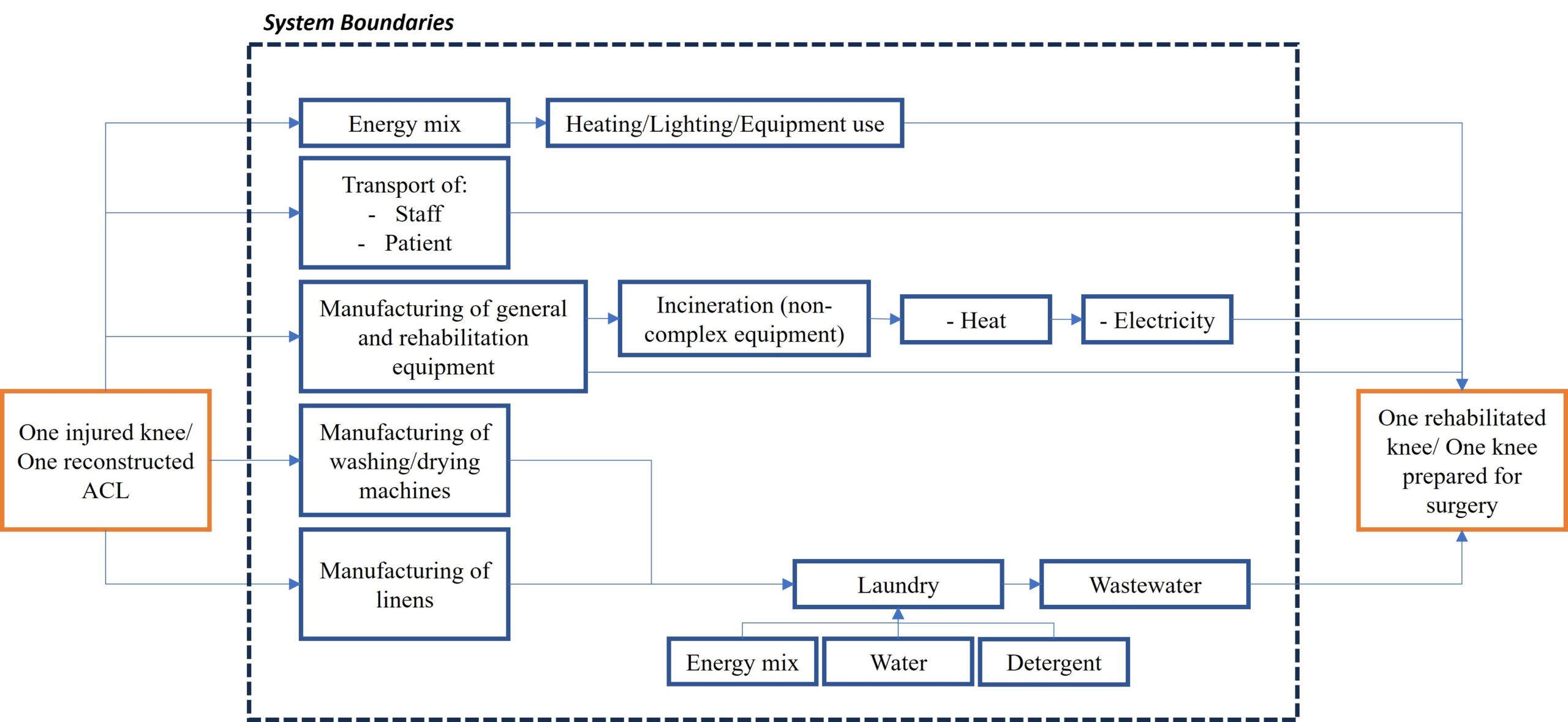
Figure 1: Inputs flowchart for physiotherapy. ACL = anterior cruciate ligament
Polina Boiko (PT, MSc Environmental Sciences)
Polina is a physiotherapist and environmental analyst in Switzerland, she is specialised in environmental profiling of healthcare activities through Life Cycle Assessment. Recently, she started learning to play the piano, massively struggling to overcome finger interdependence.
Our results showed that transportation overwhelmingly dominated the environmental burden, on average accounting for 84% of total impacts (Figure 2). Environmental performance improved sharply with more sustainable travel modes; when patients and staff walked or cycled, building heating became the main contributor instead. Laundry was another meaningful factor: washing and drying one towel per session was also an important burden hotspot. In comparison, rehabilitation equipment had smaller contributions, and waste management was negligible.
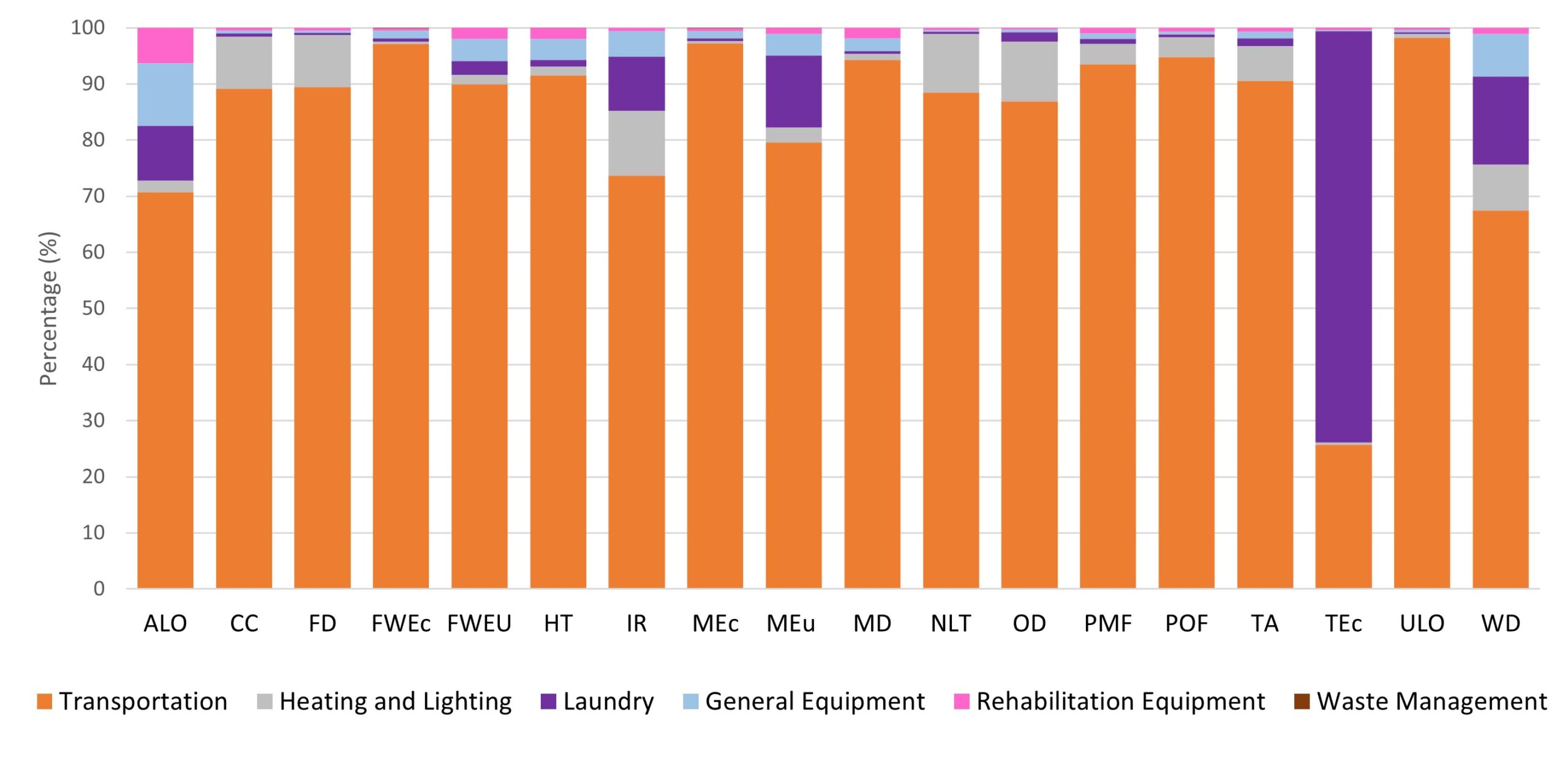
Figure 2: Relative contributions of activities associated with physiotherapy for each environmental impact category; ALO = Agricultural land occupation, CC = Climate change, FD = Fossil depletion, FWEc = Freshwater ecotoxicity, FWEu = Freshwater eutrophication, HT = Human toxicity, IR = Ionising radiation, MEc = Marine ecotoxicity, MEu = Marine eutrophication, MD = Metal depletion, NLT = Natural land transformation, OD = Ozone depletion, PMF = Particulate matter formation, POF = Photochemical oxidant formation, TA = Terrestrial acidification, TEc = Terrestrial ecotoxicity, ULO = Urban land occupation, WD = Water depletion.
These results mean that encouraging soft mobility among patients (whenever clinically possible) and staff can be particularly relevant, since such an initiative can avoid substantial environmental impacts related to physiotherapy. Also, promoting early patient’s self-management might also reduce the number of physiotherapy sessions needed to complete rehabilitation, which could also be enhanced by therapeutic education, as well as online sessions. The total number of appointments might also be reduced by fostering evidence-based practice among physiotherapists, since only half of physiotherapists seem to follow evidence-based guidelines when managing musculoskeletal conditions (4). At last, it could be recommended to avoid frequent laundry by reusing several times patient’s dedicated towels and even ask the patients to set aside and bring one of their own towels to rehabilitative sessions, as some physiotherapists already do.
Although part of this project focused on physiotherapy, the broader aim was to compare complete pathways, surgical versus conservative, after an ACL injury. The surgical pathway showed at least 8.5 times the environmental burden of the conservative pathway, which reinforces the need for careful, evidence-based patient selection for ACL surgery. Avoiding procedures with limited clinical benefit can not only improve cost-effectiveness but also reduce environmental and public health impacts.

Taken together, these insights show how physiotherapy can play a subtle but significant role in the healthcare ecological transition. We can speculate that whenever physiotherapy promotes less invasive, early, high-value care and lean pathways, it contributes to a more responsible use of resources and therefore a better environmental performance of healthcare as a whole.
At the recent EPA regional meeting, many colleagues expressed that environmental physiotherapy remains underrepresented in curricula, and too often dismissed as “tree-hugging.” I believe one of our next steps is to show that environmental thinking is not only entirely compatible with an evidence-based mindset, they are, in fact, deeply aligned. This perspective might help bring more physiotherapists on board, not only those already environmentally engaged. If you’d like to discuss the study or explore potential collaborations on how to convince EBP-oriented colleagues to support environmental considerations in healthcare, feel free to reach out, I’d be happy to continue the conversation.
References
Boiko, P. (2021). From Physiotherapy to Environmental Sciences: an ongoing path to interdisciplinarity. https://environmentalphysio.com/2021/12/02/from-physiotherapy-to-environmental-sciences-an-ongoing-path-to-interdisciplinarity/
Boiko, P., et al. (2025). Environmental life cycle assessment of surgical versus conservative care pathways for an anterior cruciate ligament injury. Journal of Cleaner Production, 535. https://doi.org/10.1016/j.jclepro.2025.147136
Saadé, M., & Jollier, O. (2024). Analyse de cycle de vie : comprendre et réaliser un écobilan. EPFL Press.
Zadro, J., et al. (2019). Do physical therapists follow evidence-based guidelines when managing musculoskeletal conditions? Systematic review. BMJ Open, 9(10). https://doi.org/10.1136/bmjopen-2019-032329
Geniale Arbeit – Danke für den Einsatz für die Physiotherapie! Mir gefällt die Herangehensweise sehr gut, ich finde sie wegweisend. Was für eine Fleißarbeit zur Erhebung der Werte! Danke.