
Physiotherapists know that bodies do not live in laboratories. A patient walks to the clinic through a hot street, a runner trains in cold wind, an older client stays indoors for days because the air is heavy and the pavement is icy. The weather is part of every patient’s day, even when nobody writes it down. Human biometeorology is the science that takes this seriously. It asks a simple question: how do weather and climate act on the human body, and what can we do about it?
The idea is old. More than two thousand years ago, the Greek physician Hippocrates told his students to look at the seasons, the winds, the waters and the places before they looked at the patient. Many of his observations still hold. What has changed is that we can now describe the thermal environment in numbers that relate to the person, not only to the thermometer. Air temperature alone says little. Sun, wind, humidity, clothing and activity decide whether a day feels comfortable or becomes a burden. One of the central messages of my book is that heat is not measured but calculated: it comes from the heat balance of the body, and the same weather can be harmless for one person and dangerous for another.
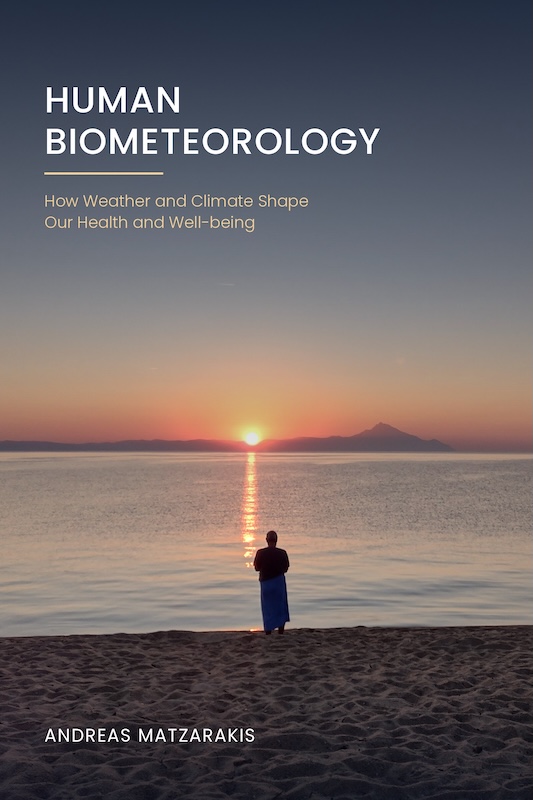
I learned this early. In July 1987 a long heat wave hit Athens, and together with a colleague I looked at it from the point of view of the human body (Matzarakis & Mayer, 1991). Since then I have worked on thermal indices such as the physiologically equivalent temperature, which expresses a complex thermal situation as one value in °C that people can understand (Höppe, 1999). The book “Human Biometeorology: How Weather and Climate Shape Our Health and Well-being” brings this experience together for readers who are not meteorologists.
The has 49 short chapters in nine parts. It begins with the basics of the heat balance and thermal comfort, then moves through heat, cold, sun and ultraviolet radiation, air quality, pollen, noise, and the city as a living space. Later parts deal with infectious diseases carried by insects and ticks, with weather sensitivity, with tourism and recreation, and with climate change and adaptation. Every chapter starts with a short lead, ends with a section on what changes in a warming climate, and offers a box with practical points to remember. For practitioners there is a special page on what climate adaptation means in everyday work.
Prof. Dr. Andreas Matzarakis
Professur für Umweltmeteorologie, University of Freiburg, Germany; external member of the University Council, Democritus University of Thrace, Greece.
Andreas Matzarakis is a bio- and environmental meteorologist at the University of Freiburg. He works on thermal comfort, heat stress and climate adaptation, and develops tools such as RayMan and the modified PET for practical use. Website: https://matzarakis.4lima.de
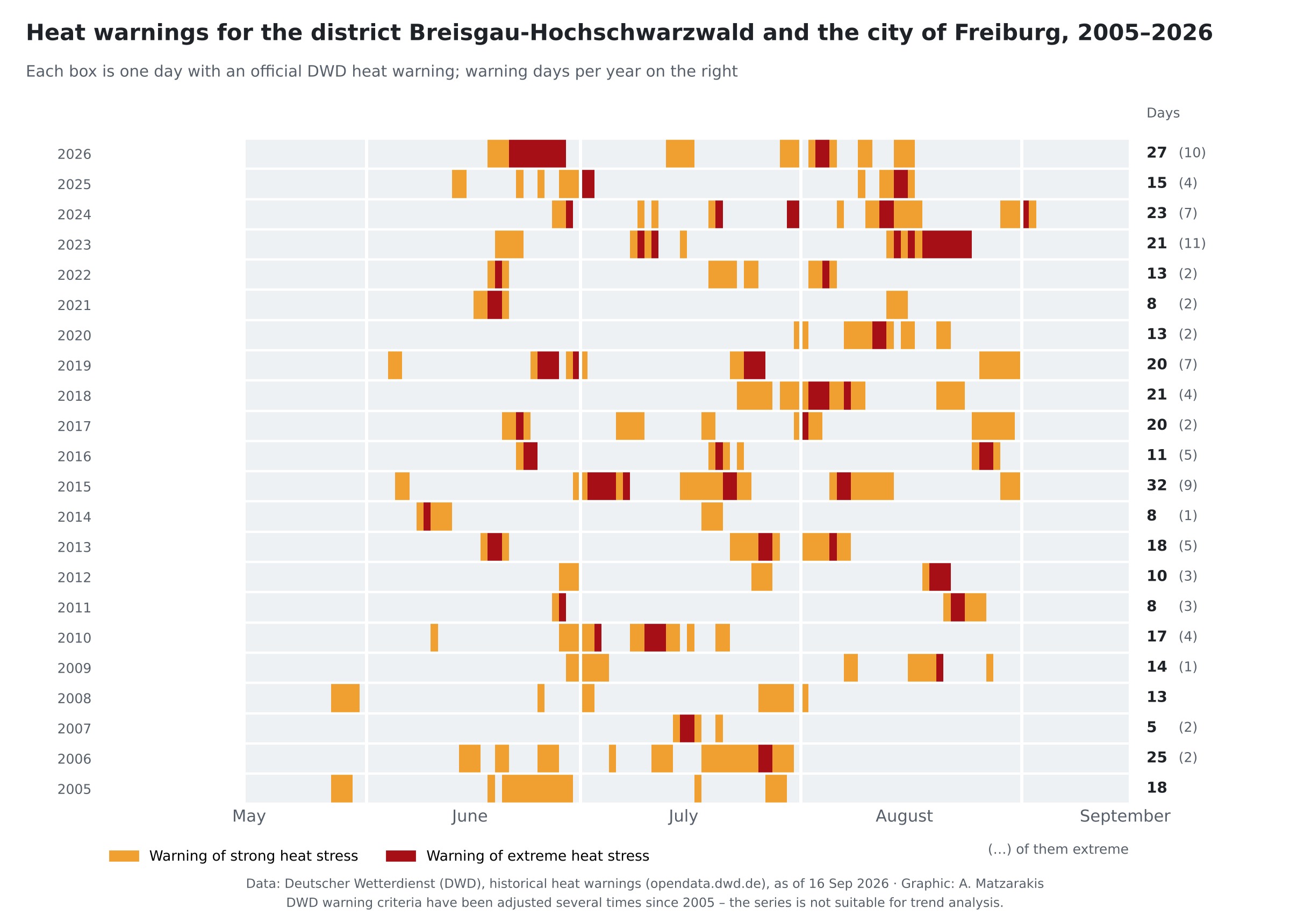
Heat warnings of the German Weather Service (DWD) for the district Breisgau-Hochschwarzwald and the city of Freiburg, 2005–2026. Data: Deutscher Wetterdienst (DWD), opendata.dwd.de, as of 16 September 2026. Graphic: A. Matzarakis. Note: Warning criteria were adjusted several times since 2005, so the series is not suitable for trend analysis.
I am a meteorologist, not a clinician, so the book looks at the weather and the environment and leaves treatment to the professionals. For environmental physiotherapy, several themes may be useful. Older people, children, people with chronic disease and those who work or exercise outdoors react differently to the same day, and the book explains why. It shows how to read a heat warning, why the first hot days of the year are often the hardest, and how clothing and timing of activity can reduce strain. It also looks at cold, at ultraviolet radiation, at ozone and at pollen, which matter for rehabilitation outdoors and for advice given to patients. A closing chapter collects ten lessons, and a self-test lets readers check what they know and how weather-sensitive they are themselves.
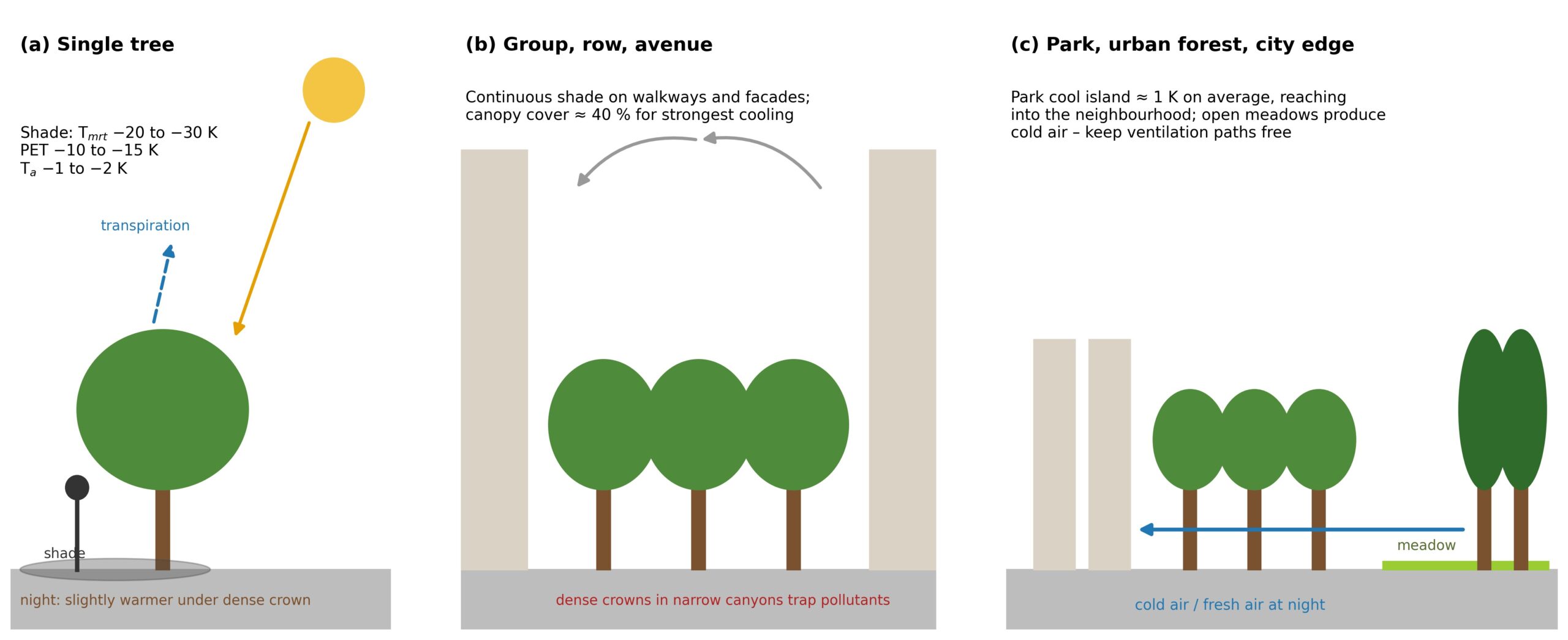
How trees act on the urban climate, from a single tree to a group, an avenue and a park. Graphic: A. Matzarakis (own graphic, free to use for this post).
My aim was a book that is simple, practical and close to people. It uses plain language, many figures and examples from several regions of the world, and it keeps the human being at the centre. It is free to read and download, as a PDF in book format and in a pocket-sized A5 format, and may be shared under a Creative Commons licence. I would be glad if members of the Environmental Physiotherapy Association use it in teaching, in patient education or as a starting point for discussion. Weather will not go away, and with a changing climate, patients will meet more extreme days. Understanding how the atmosphere reaches the body is a good first step towards helping people live with it.
The book is available at https://matzarakis.4lima.de/humanbiometeorology.htm
Copyright and licence
© 2026 Andreas Matzarakis. The book “Human Biometeorology: How Weather and Climate Shape Our Health and Well-being” (ISBN 978-3-00-088330-9) is published by the author and licensed under Creative Commons Attribution-NonCommercial-NoDerivatives 4.0 International (CC BY-NC-ND 4.0, https://creativecommons.org/licenses/by-nc-nd/4.0/). It may be shared with attribution, for non-commercial purposes and without changes. The text of this blog post is © 2026 Andreas Matzarakis and may be published by the Environmental Physiotherapy Association on its blog and shared on its channels.
AI declaration
This post is based on the author’s own book. An AI assistant (Claude, Anthropic) supported the drafting and the language editing; the author checked, corrected and approved the text and is responsible for its content. No AI-generated images are used.
References
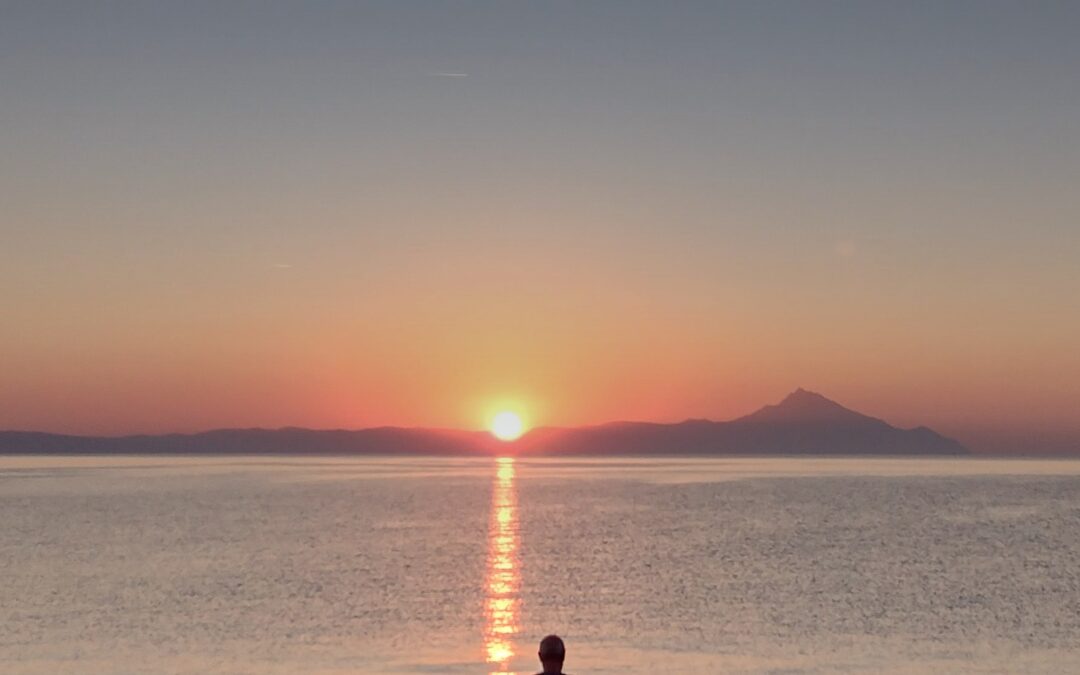
Header image: Sunrise over the Aegean Sea with Mount Athos on the horizon. Photo: Irene Matzarakis, used with permission; the full photo is the cover of the book.
Höppe, P. (1999). The physiological equivalent temperature – a universal index for the biometeorological assessment of the thermal environment. International Journal of Biometeorology, 43(2), 71–75.
Matzarakis, A. (2026). Human biometeorology: How weather and climate shape our health and well-being. ISBN 978-3-00-088330-9. https://matzarakis.4lima.de/humanbiometeorology.htm
Matzarakis, A., & Mayer, H. (1991). The extreme heat wave in Athens in July 1987 from the point of view of human biometeorology. Atmospheric Environment, 25B(2), 203–211. https://doi.org/10.1016/0957-1272(91)90055-J
Looking forward to reading this and sharing it with my peers!
Thank you very much for sharing your book and expertise with us!